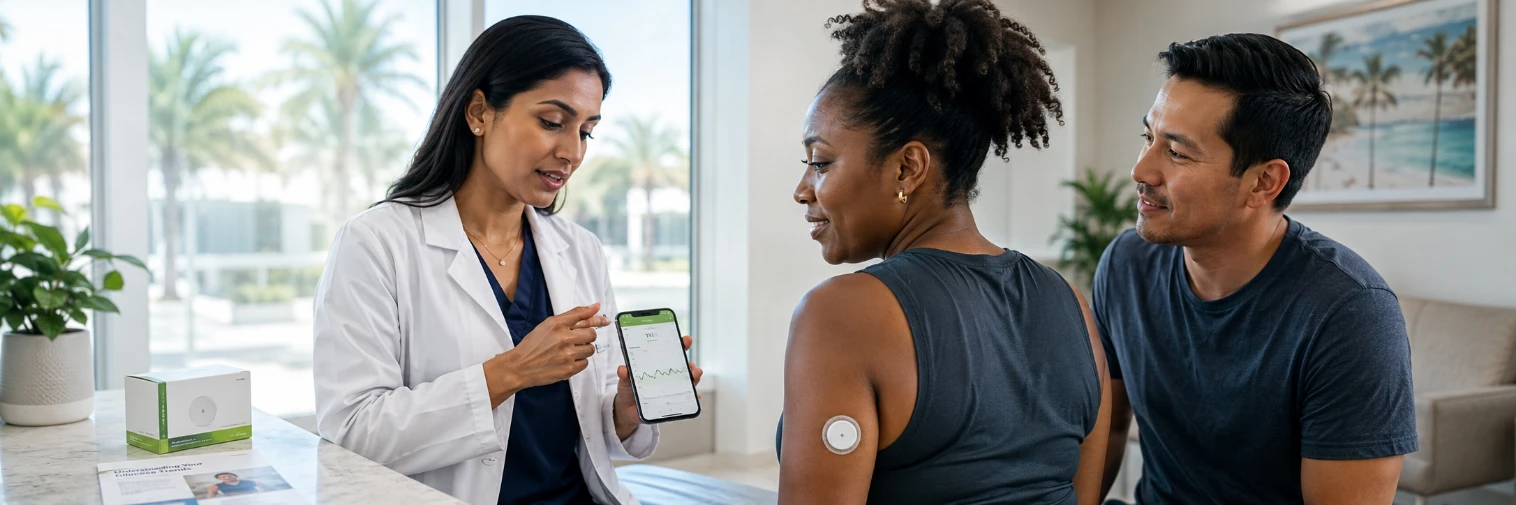
An over the counter continuous glucose monitor can show how glucose changes across meals, activity, sleep, stress, and daily routines. The appeal is easy to understand: instead of one blood draw, you see a stream of readings. That detail can be useful, but more data does not automatically mean better decisions. The value depends on the question you are trying to answer and what you do with the information.
For someone in Fort Myers who has been told that blood sugar is “a little high,” a wearable may seem like an easy way to investigate. A person without diabetes may also want to compare breakfast, a restaurant meal, or an evening walk. Those are reasonable questions, yet a sensor cannot replace laboratory testing used to diagnose prediabetes or diabetes. At Fountain of Youth in Fort Myers, Florida, staff stays current on developments in consumer glucose monitoring so patients can bring wearable data into a broader primary care conversation. The practical goal is to separate useful patterns from numbers that create concern without changing care.
Turning CGM Numbers Into a Primary Care Decision
- Compare repeated sensor trends with established testing such as A1C or fasting glucose instead of trying to diagnose yourself from one curve.
- Review symptoms, medications, meals, activity, sleep, and prior lab results so unusual readings have clinical context.
- Decide whether the data points to a useful habit change, appropriate lab testing, or a primary-care follow-up rather than continued tracking for its own sake.
Have CGM Data but No Clear Next Step?
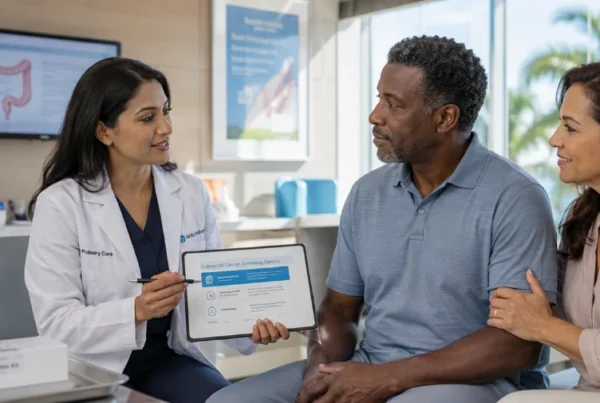
A direct primary care relationship can give you more time to review patterns, symptoms, laboratory results, and follow-up questions before deciding what actually needs attention.
Physician-reviewed content • Evidence-aware care • Personalized treatment planning
Make the Data Serve a Specific Question
If you are still deciding whether membership-based care fits the way you want to handle ongoing questions, review the DPC FAQs and see who provides your care.
What an OTC Glucose Monitor Actually Measures
A continuous glucose monitor uses a small sensor placed in tissue under the skin. It estimates glucose in interstitial fluid, the fluid between cells, rather than directly measuring a venous blood sample. Readings move to an app or receiver repeatedly through the day, creating a trend line instead of one snapshot. That design is useful for seeing direction, timing, and repeated responses.
The FDA cleared the first OTC system, Dexcom Stelo, for adults in March 2024, removing the prescription requirement for its intended users. The original adult clearance included people who do not use insulin and people without diabetes who want to see how diet and exercise affect glucose. Stelo is not intended for people with problematic hypoglycemia, and medical decisions still require appropriate clinical input. OTC access makes glucose data easier to collect; it does not turn every reading into a diagnosis. That distinction matters when an app shows a number that looks alarming by itself.
Where the Data May Be Worth Having
Prediabetes: Use the Sensor as Feedback, Not a Diagnosis
A CGM for prediabetes may be useful when someone already has a clinical reason to work on glucose-related habits. The sensor can show repeated patterns, such as a different response after one breakfast or after a post-meal walk. The useful part is the pattern linked to a practical change, not the novelty of watching the graph.
CGM has been studied in prediabetes mainly as part of lifestyle interventions. Small trials have reported better short-term glucose measures when CGM feedback was paired with nutrition education or structured coaching. The 2026 review of non-diabetic populations found signals of improved mean glucose and behavioral adherence, but no significant body-mass-index benefit. A separate 2026 JAMA Internal Medicine review found no established routine benefit for people with prediabetes, obesity, or type 2 diabetes who were not receiving glucose-lowering therapy. Some people may change behavior without proving that routine device use improves long-term health for everyone. Short, goal-directed use therefore makes more sense than assuming indefinite wear is necessary.
People who like concrete feedback may get more from the experience than people with a stable routine and normal laboratory results. A sensor can test a specific question, such as whether a regular meal produces similar responses on different days. It can also show whether activity after a meal changes the curve for that person. The result becomes useful when it supports a sustainable habit rather than a perfectly flat line.
When the Graph Raises More Questions
If the same pattern keeps appearing, or the sensor does not match symptoms or prior labs, a primary care discussion can help determine whether established testing or another evaluation is more useful than collecting more sensor data.
Why One Glucose Spike Can Mislead You
Glucose normally changes after eating, and the rise can vary from one day to another. Meal composition, portion size, activity, sleep, illness, stress, and sensor variation can affect the graph. A single peak has less clinical meaning than a repeated pattern. Symptoms, history, and laboratory results add context. Problems arise when one unusual curve becomes proof that a healthy food is “bad.” Fruit, whole grains, and other nutritious foods should not be discarded solely because an app displayed a temporary rise.
Sensor Readings Are Not Laboratory Results
CGM and laboratory testing measure related information in different ways. A sensor estimates glucose in interstitial fluid, while a laboratory glucose test measures blood and an A1C reflects longer-term glycemic exposure. Interstitial readings can lag behind blood glucose when levels change quickly, so results taken around the same time may not match exactly. A surprising wearable result therefore needs context before it becomes a conclusion.
Apps can make the data look more precise than the biological situation is. A smooth curve may still reflect sensor error, physiologic delay, and normal day-to-day variability. Different meals can produce different curves even when both fit a healthy eating pattern. A number that is unusual for you may matter more than someone else’s screenshot or an online “ideal” range. Healthy people do not have a universally accepted CGM target for every post-meal fluctuation. Recent patient guidance notes that the meaning of glucose fluctuations in people without diabetes remains uncertain.
When a Blood Test Matters More Than a Wearable
Anyone asking “Do I have prediabetes?” needs diagnostic testing rather than a consumer sensor alone. The 2026 American Diabetes Association standards do not support CGM for screening or diagnosing prediabetes or diabetes. Prediabetes is identified with validated tests such as A1C, fasting plasma glucose, or a two-hour oral glucose tolerance test. Those tests have established thresholds that consumer CGM patterns do not replace.
Primary care review matters more when repeated abnormal-looking patterns occur with risk factors, symptoms, or prior abnormal laboratory results. Excessive thirst, frequent urination, or unexplained weight loss can warrant medical evaluation rather than another week of tracking. A sensor reading that repeatedly conflicts with how you feel is another reason to verify what is happening. Medication changes should not be made from OTC CGM data without clinician input. A wearable can supply context, but clinical assessment determines whether further testing is appropriate.
How to Use CGM Data Without Letting It Run Your Diet
A useful experiment starts with one or two questions rather than a plan to optimize every number. You might compare two familiar breakfasts or observe days with and without a post-meal walk. Keep the rest of the routine reasonably similar when possible so the comparison has meaning. Repeated observations are more useful than reacting to the highest point on one day.
Food quality should remain broader than a glucose curve. A meal can affect glucose modestly and still be nutritionally poor, while a nutrient-dense food can create a noticeable rise. A flat graph is not a complete definition of a healthy diet.
People prone to health anxiety or rigid eating rules should be cautious with constant biometric feedback. Recent patient guidance warns that CGM use without diabetes may encourage unnecessary restriction of healthy foods and an overly narrow focus on numbers. The FDA also cautioned that the first adult OTC system was not designed for people with problematic low blood sugar. A short trial should have a stopping point, a question to answer, and a plan for the result. Data that creates distress without producing a useful decision may not be worth continuing.
What to Bring to a Primary Care Visit
Raw screenshots are less useful than a short record connecting the graph to what was happening. Bring several representative days, note meal timing, activity, sleep disruptions, illness, and symptoms, and flag repeated patterns. Include recent A1C or fasting glucose results if you have them. That combination gives primary care more context for deciding whether the sensor pattern matters.
Patterns Worth Reviewing
Repeated elevations at similar times deserve more attention than one unusual peak. A consistent mismatch between CGM readings and prior laboratory results is worth discussing, especially when it is large or persistent. Symptoms occurring alongside unusual sensor readings should be documented rather than explained away by the device. A clinician may decide that repeat A1C, fasting plasma glucose, an oral glucose tolerance test, or another evaluation is more useful than extending CGM wear. The right follow-up depends on the clinical picture rather than the shape of one curve.
Is an OTC CGM Worth the Cost?
Cost makes the “useful data or expensive noise” question practical. CGM use also asks for time and attention, not just money. The purchase is easier to justify when you have a defined question that the data can realistically help answer.
A person with confirmed prediabetes who wants structured feedback around meals and activity may have a clearer use case than a healthy person trying to eliminate every rise. A limited experiment before a primary care follow-up may also be reasonable when the results will be reviewed in context. Ongoing use is harder to justify when it produces the same information each month without changing behavior or medical decisions. A normal laboratory evaluation does not become more informative simply because thousands of sensor points are collected, so the best return comes from turning a useful pattern into a sustainable habit and knowing when enough data is enough.
Questions a CGM Cannot Answer by Itself
A glucose curve answers a narrow question: how sensor-estimated glucose changed over time. Several common health questions need other information, even when the graph looks detailed.
| Question | What usually adds the missing context |
|---|---|
| Do I have prediabetes? | A1C, fasting plasma glucose, or an oral glucose tolerance test. |
| Is my overall diet healthy? | Food quality, nutrient adequacy, portions, preferences, and the full eating pattern. |
| What is my cardiovascular risk? | Blood pressure, lipids, smoking history, age, family history, and other clinical factors. |
| Are my kidneys healthy? | Appropriate blood and urine testing interpreted with medical history. |
| Should I change a medication? | A clinician review of the medication, diagnosis, symptoms, labs, and treatment goals. |
| What is causing my symptoms? | Clinical evaluation rather than assuming glucose is the cause. |
When CGM Results Deserve a More Complete Review
Wearable data becomes more useful when it is connected to a real clinical question rather than judged as an isolated score.
- Repeated high-looking patterns appear alongside prior abnormal A1C or fasting glucose results.
- Symptoms such as excessive thirst, frequent urination, unexplained weight loss, or feeling unwell occur while sensor readings look unusual.
- You have changed meals, activity, or other routines based on the graph but are unsure whether those changes are medically useful or unnecessarily restrictive.
For recurring questions that benefit from continuity, you can review the membership structure and decide whether that care model fits your needs.
Common Questions About OTC Glucose Monitors
Can a CGM diagnose prediabetes?
No. Current ADA guidance does not support CGM for screening or diagnosis of prediabetes or diabetes. Diagnosis relies on validated blood tests such as A1C, fasting plasma glucose, or the two-hour oral glucose tolerance test. A CGM pattern can add context, but it cannot replace those methods.
Is one high reading after a meal dangerous?
One post-meal rise does not establish a diagnosis or prove that a food is harmful. Glucose changes after eating, and meal size, activity, stress, sleep, sensor timing, and normal variability can affect the curve. Repeated patterns, symptoms, and laboratory results matter more than one isolated point.
Can I use Stelo if I do not have diabetes?
The FDA’s original adult OTC clearance included people without diabetes who want to understand how diet and exercise affect glucose. That does not mean every person without diabetes will gain a health benefit from wearing one. Studies have not demonstrated broad health improvement or diabetes prevention from CGM use in people without diabetes. A defined question and limited trial are more defensible than open-ended monitoring without a clinical reason.
When should I discuss CGM results with primary care?
Bring the data in when abnormal-looking patterns repeat, symptoms occur, or sensor results conflict with prior laboratory testing. Primary care can decide whether established diagnostic tests or another evaluation is needed. Wearable data is most useful when it adds context to a medical question rather than trying to answer the question by itself.
Choose the Next Step Based on the Question
If you want ongoing help putting glucose trends, laboratory results, prevention, and follow-up into context, compare how DPC works with the answers in our membership FAQs.
Medical review: Reviewed by Dr. Keith Lafferty MD, Fort Myers on September 14, 2026. Fact-checked against government and academic sources; see in-text citations. This page follows our Medical Review & Sourcing Policy and undergoes updates at least every six months.