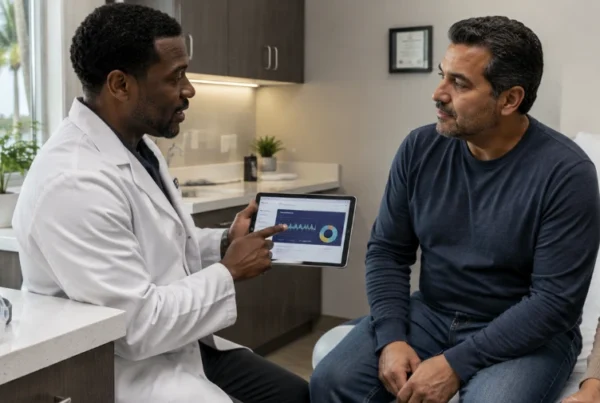
A blood test for colon cancer screening is now a real option for some adults, but it does not replace the strengths of stool testing or colonoscopy. For patients in Fort Myers, that means colorectal screening conversations in 2026 may include a blood draw alongside more established choices. The most important distinction is that a blood test can detect many existing colorectal cancers, yet it is much less effective at finding advanced precancerous growths. Screening still works best when the test chosen matches a person’s risk level and is followed through appropriately.
A Screening Choice Should Start With Your Risk
- Confirm whether you are truly average risk before choosing a blood-based screening option.
- Compare convenience with each test’s ability to detect cancer and advanced precancerous lesions.
- Plan in advance for what happens after a positive result, including the need for colonoscopy.
Not Sure Which Screening Path Fits?
A primary care visit can provide time to review age, family history, previous tests, symptoms, and how direct primary care can support ongoing preventive planning.
Physician-reviewed content • Evidence-aware care • Personalized treatment planning
Bring the Right Questions to the Visit
You can review the primary-care provider on our team page and use our preventive wellness care guide to prepare for a broader screening discussion.
Colorectal cancer remains a major health concern in the United States. The American Cancer Society estimated 158,850 new colorectal cancer cases and 55,230 deaths in 2026, figures summarized in its 2026 colorectal estimates. Screening can matter before symptoms appear because some methods can identify cancer early, and colonoscopy can also find and remove certain precancerous polyps. A blood-based option may make screening easier for people who have delayed other tests, but convenience is only one part of the decision. The test’s limits, follow-up requirements, and a person’s family and medical history still matter.
What Changed for Colorectal Screening by 2026?
The key change began on July 26, 2024, when the U.S. Food and Drug Administration approved Shield for colorectal cancer screening in adults age 45 and older who are at average risk. The FDA approval record states that Shield detects colorectal cancer-related alterations in cell-free DNA from blood and that a positive result should be followed by colonoscopy. Shield is not intended to replace diagnostic colonoscopy or surveillance colonoscopy in people at high risk. That limitation is important for anyone already on a higher-risk surveillance plan.
By 2026, blood-based screening had moved further into mainstream colorectal screening guidance. The 2026 ACS guideline reaffirmed screening beginning at age 45 for average-risk adults and added guidance on blood-based tests. The guideline still prefers high-sensitivity stool testing and structural exams, including colonoscopy, over blood-based testing. Blood-based tests are recommended mainly for people who decline or do not complete a preferred screening method. That positioning matters because a newer test can be useful without being equivalent to every established option.
The screening age itself did not change in 2026. Average-risk adults generally should begin colorectal cancer screening at 45, and routine screening commonly continues through 75 for people in good health with a life expectancy greater than 10 years. Decisions from ages 76 through 85 are individualized based on health, prior screening, and preferences.
What the Shield Blood Test Actually Looks For
Shield is a blood-based colorectal cancer screening test that analyzes cell-free DNA circulating in the bloodstream. Cancer cells can release DNA fragments with molecular changes that differ from normal DNA. The laboratory looks for patterns associated with colorectal cancer and reports a screening result rather than directly viewing the colon. A routine blood draw can therefore provide information without bowel preparation, stool collection, sedation, or an endoscopic procedure.
The supporting study compared the blood test with colonoscopy in nearly 8,000 people. According to an NCI review, Shield detected colorectal cancer in more than 83% of participants who had cancer found on colonoscopy. The same report noted much lower sensitivity for advanced precancerous growths, at about 13%.
That gap is central to understanding what the test can and cannot do. A screening method that finds an existing cancer can support earlier evaluation, but a method that finds precancerous lesions may also help prevent some cancers from developing. Colonoscopy has a prevention advantage because a clinician can see and remove many suspicious polyps during the procedure. Stool-based tests can also detect signals associated with cancer or advanced lesions, though a positive stool result still requires colonoscopy. The Shield blood test offers a different trade-off: easier collection for many patients, but weaker detection of advanced precancerous lesions.
Turn the Screening Choice Into a Follow-Up Plan
If you are deciding between FIT, stool DNA, colonoscopy, and a blood test, primary care can help organize the trade-offs, timing, and follow-up expectations. Our DPC FAQs explain how the membership relationship works around routine care planning.
How Blood Screening Compares With Other Options
Colorectal Screening Options at a Glance
Each screening method asks something different of the patient and has a different follow-up pathway. The table below highlights practical distinctions that can shape a screening discussion without treating any one method as universally best.
| Screening option | Typical interval for average-risk screening | What the patient does | Key practical point |
|---|---|---|---|
| FIT | Every year | Collects a stool sample at home | Looks for hidden blood; a positive result needs colonoscopy |
| Multitarget stool DNA | Every 3 years | Collects a stool sample at home | Looks for blood and molecular markers; a positive result needs colonoscopy |
| Colonoscopy | Every 10 years after a normal exam for many average-risk adults | Completes bowel preparation and undergoes an endoscopic exam | Can directly inspect the colon and remove many polyps during the same procedure |
| Cell-free DNA blood test | Often discussed on a 3-year schedule; the optimal long-term interval is still being studied | Provides a blood sample | Convenient collection, but lower sensitivity for advanced precancerous lesions and stage I cancer than preferred options |
| CT colonography | Every 5 years | Completes bowel preparation and has CT imaging of the colon | No sedation is usually needed, but an abnormal finding still leads to colonoscopy |
Some people search for a colonoscopy alternative blood test because they want to avoid bowel preparation, sedation, time away from work, or stool collection. A blood draw can reduce several of those barriers, which may make screening more acceptable to someone who otherwise would not complete it. That does not make the tests interchangeable. Colonoscopy directly examines the colon, FIT checks for hidden blood in stool, stool DNA testing looks for multiple markers in stool, and blood-based testing looks for cancer-related signals in circulation.
Screening intervals also affect the commitment over time. FIT depends on yearly repetition, stool DNA testing is generally less frequent, and a normal screening colonoscopy may not need to be repeated for 10 years in many average-risk adults. Blood-based screening is often discussed on a three-year schedule, but the 2026 ACS guideline notes uncertainty about the optimal interval for long-term effectiveness. Repeat testing still matters. A person choosing a less invasive test needs a plan to stay on schedule.
Who Is a Good Candidate for a Blood-Based Test?
Shield is intended for adults age 45 and older who are at average risk for colorectal cancer. That generally means the person is being screened before symptoms appear and does not have a history that places them into a high-risk surveillance pathway. A blood-based test may be considered when someone is unwilling or unable to complete a preferred stool-based test or structural exam. The decision should come after a discussion of what the blood test may miss as well as what it can detect.
Family history can change that conversation. A parent, sibling, or child with colorectal cancer, especially at a younger age, may affect when screening should begin and which method is most appropriate. Personal history of colorectal cancer or certain polyps, inflammatory bowel disease, and hereditary cancer syndromes can also move someone out of the average-risk category. People with these factors may need earlier or more intensive screening rather than relying on a blood-based screening test. A routine screening choice should not substitute for an individualized surveillance plan.
Symptoms are another reason not to treat a screening blood test as a catch-all answer. Rectal bleeding, ongoing abdominal pain, diarrhea, or iron-deficiency anemia can require diagnostic evaluation rather than routine screening. A clinician may recommend colonoscopy or another workup based on the full picture.
What a Positive or Negative Blood Result Means
A positive Shield result does not diagnose colorectal cancer by itself. It means the test found a signal that warrants further evaluation, and colonoscopy is needed to complete the screening process. The colonoscopy can identify cancer, locate polyps, and allow removal or biopsy of suspicious tissue. Repeating the blood test instead of completing the colonoscopy is not the intended follow-up pathway.
A negative result also has limits. The FDA notes that a negative Shield result does not guarantee that colorectal cancer is absent. The test can miss some cancers, especially earlier-stage disease, and it misses many advanced precancerous lesions.
That means a negative blood result should not become a reason to ignore future screening or new symptoms. Screening is a repeated process, not a one-time clearance. The next screening date should be documented, and any new symptoms should be evaluated on their own merits. People with a change in family history or a new medical risk factor may also need their plan adjusted. A normal blood result cannot convert a high-risk person into an average-risk screening pathway.
Choosing Among Colorectal Screening Options
The most useful screening conversation starts with risk, then moves to the practical barriers that could keep someone from following through. One patient may prefer annual FIT because it is simple to complete at home, while another may choose stool DNA testing because it is less frequent. Someone who wants a direct examination and the possibility of polyp removal may choose colonoscopy. A person who has repeatedly declined those preferred methods may decide that blood-based colorectal cancer screening is a workable path. The key is to choose a method that is medically appropriate and then complete the required follow-up.
At Fountain of Youth in Fort Myers, Florida, staff stays current on developments in colorectal cancer screening so patients can discuss how blood-based options fit alongside established tests. A primary care visit can also help sort out whether someone is truly average risk, overdue for screening, or better served by a colonoscopy-based plan. Insurance coverage, prior test results, family history, and personal preferences can all affect the next step.
Questions? We are here to help! Call 239-355-3294.
A Primary Care Discussion May Be Useful If…
The test itself is only one part of screening. Risk level, symptoms, prior results, and the follow-up plan can change which option makes sense.
- You are 45 or older and are unsure whether a blood test, stool test, or colonoscopy fits your history and preferences.
- A family history of colorectal cancer, prior polyps, inflammatory bowel disease, or another risk factor may move you outside an average-risk pathway.
- You have a positive screening result, new rectal bleeding, persistent abdominal symptoms, or iron-deficiency anemia and need help understanding the appropriate diagnostic next step.
A structured primary-care review can make the next step clearer without treating every patient as if the same screening pathway applies.
Frequently Asked Questions
Can a blood test replace a colonoscopy for colon cancer screening?
A blood test can be used as a screening option for some average-risk adults, but it is not a full replacement for colonoscopy. Blood-based tests are less sensitive for advanced precancerous lesions, and a positive blood test still requires colonoscopy. Colonoscopy also has the advantage of allowing many polyps to be removed during the same procedure.
At what age should colon cancer screening start?
Average-risk adults generally should begin colorectal cancer screening at age 45. Routine screening commonly continues through age 75 for people in good health, with individualized decisions from ages 76 through 85. People with a family history or other higher-risk conditions may need a different starting age or screening plan. Symptoms can also call for diagnostic evaluation regardless of routine screening age.
What happens if the Shield blood test is positive?
A positive result should be followed by colonoscopy to complete the screening process. The blood test cannot show where an abnormality is located or remove a polyp. Colonoscopy allows the colon to be examined directly and suspicious tissue to be sampled or removed.
Does a negative Shield test mean I do not have colon cancer?
No screening blood test can guarantee that colorectal cancer is absent. Shield can miss some cancers and has limited sensitivity for advanced precancerous growths. A negative result should be followed by future screening at the appropriate interval rather than treated as permanent clearance. New symptoms or a change in risk should prompt a separate discussion with a clinician.
Keep Preventive Care Moving Forward
If colorectal screening is one item on a larger preventive-care list, review our membership options or contact the DPC team to discuss how ongoing primary care can support screening follow-through, routine risk review, and future care planning.
Medical review: Reviewed by Dr. Keith Lafferty MD, Fort Myers on October 4, 2026. Fact-checked against government and academic sources; see in-text citations. This page follows our Medical Review & Sourcing Policy and undergoes updates depending on topic relevant developments.