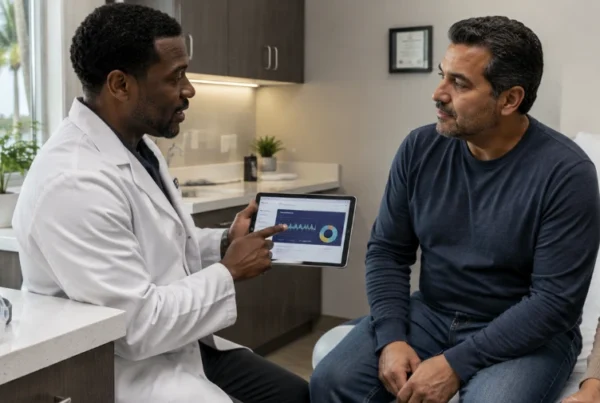
Cervical cancer screening is changing for people who have delayed testing because a pelvic examination feels uncomfortable, difficult, or hard to schedule. In Fort Myers, some eligible patients can now use a prescription-based option to collect a vaginal sample privately for high-risk human papillomavirus testing. The sample can be collected at home with an FDA-authorized device when the testing pathway allows it. Screening still involves a healthcare provider and laboratory, and an abnormal result can lead to in-person follow-up.
Is At-Home HPV Screening the Right Next Step?
- Confirm eligibility: Age, screening history, prior results, and individual risk can affect whether self-collection fits the current screening pathway.
- Separate screening from symptoms: Bleeding, pelvic pain, or concerning discharge can require diagnostic evaluation rather than routine screening alone.
- Plan for the result: Negative, positive, and invalid results can lead to different screening intervals or follow-up steps.
Turn a Screening Option Into a Complete Care Plan
Fountain of Youth DPC provides membership-based primary care in Fort Myers for patients who want time to review screening history, current guidance, and follow-up questions. See how DPC works before deciding whether self-collection fits your situation.
Physician-reviewed content • Evidence-aware care • Personalized treatment planning
Know Who You Are Working With
Review the primary-care team or read the DPC FAQs before reaching out.
An at-home HPV test is not the same as buying an unrestricted over-the-counter kit and interpreting it yourself. A May 2025 FDA authorization letter covers the Teal Wand, a prescription device for self-collection of vaginal specimens. It can be used at home or in another private setting with a validated FDA-approved HPV molecular assay. A healthcare professional therefore remains part of the process. Home collection devices must be used with the HPV assays for which they were validated. They should not be treated as interchangeable.
What Changed in 2026, and What Changes in 2027?
On January 5, 2026, the Health Resources and Services Administration updated federal women’s preventive-services guidance for cervical cancer screening. The updated screening guidance designates high-risk HPV testing, using a patient-collected or clinician-collected sample, as the preferred screening modality for average-risk women ages 30 through 65 while retaining cervical cytology as an option. For average-risk women ages 21 through 29, the recommendation continues to use cervical cytology, commonly called a Pap test. A home cervical screening test therefore does not replace every Pap test at every age.
The insurance timeline is separate from the clinical update. HRSA states that most insurance plans are required to begin coverage of the new screening guideline on January 1, 2027, including additional testing needed to complete screening for malignancies. Coverage during 2026 can therefore depend on the current plan and test pathway. Someone considering a self collected HPV test in Florida should verify benefits rather than assume the 2027 requirement is already in effect. Primary care can help identify what to ask the insurer, laboratory, or prescribing service before collection.
Another guideline may look different without contradicting the federal change. The American Cancer Society starts average-risk screening at age 25 and includes self-collected HPV testing as an option, while preferring clinician-collected cervical samples when accessible. Age, risk history, the guideline being followed, and the FDA-authorized system all affect which screening route fits a patient.
Who May Qualify for HPV Self-Collection?
The 2026 HRSA recommendation applies to average-risk women ages 30 through 65 when patient-collected high-risk HPV testing is used. Self-collection is for screening, so it is most relevant to people without symptoms that already require diagnostic evaluation. Previous Pap or HPV results matter because cervical precancer, cervical cancer, or certain abnormal results may require surveillance instead. Immune-system conditions or medications that suppress immunity can also change screening needs. A clinician can review those details before deciding whether self-collection is appropriate.
Having a cervix is another part of the decision. A person who has had a hysterectomy may have different screening needs depending on why surgery was performed and whether the cervix was removed. Screening history also matters near the upper end of the routine screening age range because stopping screening depends on prior results, not age alone. At Fountain of Youth in Fort Myers, Florida, staff stays current on developments related to at-home HPV testing so patients can discuss how changing options fit into primary care.
Convenience can be a meaningful reason to ask about self-collection, but it does not determine eligibility. Someone who has postponed screening because of exam discomfort, mobility challenges, privacy concerns, transportation problems, or scheduling may find the option useful. The safer route is to confirm that screening is due and that the patient fits an average-risk pathway before relying on a self-collected specimen.
Bring Your Screening History Into the Decision
Self-collection may be appropriate for some average-risk patients, but prior abnormal tests, symptoms, or surveillance needs can change the route. Our preventive care guide explains how routine screening fits into broader primary-care planning.
How Self-Collection Differs From a Pap Test
The sample and the question are different
An HPV self collection test looks for high-risk HPV in a vaginal specimen collected by the patient. A Pap test examines cervical cells for abnormal changes, and those cells are collected by a healthcare professional during a speculum examination. The tests differ in both the sample and what the laboratory evaluates. Self-collected HPV screening is primary HPV testing, not a Pap test performed at home.
That distinction matters after an abnormal result. A vaginal sample can identify high-risk HPV, but it does not provide the same cervical-cell sample used for cytology or some follow-up testing. The NCI self-collection guidance says self-collected vaginal specimens are acceptable for primary HPV screening in asymptomatic, average-risk individuals, while clinician-collected cervical specimens are preferred after prior abnormal results, colposcopy, or treatment. A patient with an abnormal history should not assume a home specimen is the correct next test. Primary care can help separate routine screening from surveillance before ordering.
Can you have an HPV test without a pelvic exam?
For the initial self-collected sample, an eligible patient can collect from the vagina without a clinician performing a pelvic or speculum examination. The device includes instructions, and the specimen goes to a laboratory for high-risk HPV testing. That can help someone whose main barrier has been the examination itself. A no-exam collection option does not eliminate pelvic examinations in other situations.
A positive or otherwise abnormal self-collected HPV result can lead to a return visit for cervical sampling, and some patients may need colposcopy or another procedure based on the result and their history. Symptoms can also make an examination appropriate even when routine screening is due. The goal of self-collection is to provide another way to complete screening, not to remove diagnostic care when it becomes necessary.
What Positive, Negative, or Invalid Results Mean
A negative self-collected HPV result means the laboratory did not detect the high-risk HPV types targeted by that test. It does not mean screening can stop permanently, and it does not rule out other causes of gynecologic symptoms. The American Cancer Society recommends repeating self-collected HPV screening in three years after a negative result for people following its average-risk guideline. Clinician-collected primary HPV screening uses a different interval under that guideline. A clinician can match the result to the schedule that applies to the patient.
A positive result means the assay detected one or more high-risk HPV types. It does not mean cervical cancer is present. Follow-up may involve a clinician-collected cervical sample, additional laboratory testing, or colposcopy depending on the result and prior history. Patients should complete follow-up even when they feel well because cervical precancer may cause no obvious symptoms.
An invalid result means the laboratory could not produce a reportable result from the specimen. Collection, specimen adequacy, transport, processing, or test controls can contribute, depending on the system. The usual next step is to follow the clinician or laboratory’s instructions about repeating collection or using another screening method rather than treating the result as negative.
How common screening routes differ
Screening options differ by specimen, collector, and whether a pelvic examination is needed. The comparison below highlights practical differences without assuming one pathway fits everyone.
| Screening route | Sample used | Who collects it | Pelvic/speculum exam for collection? | Typical next issue to consider |
|---|---|---|---|---|
| At-home self-collected HPV screening | Vaginal specimen | Patient | No for initial collection | Provider review and follow-up if abnormal |
| In-clinic self-collected HPV screening | Vaginal specimen | Patient in a private clinical setting | No for initial collection | Provider review and follow-up if abnormal |
| Clinician-collected primary HPV screening | Cervical specimen | Healthcare professional | Yes | Screening interval and any reflex testing |
| Pap test | Cervical cells | Healthcare professional | Yes | Cytology result and follow-up if abnormal |
| HPV/Pap co-testing | Cervical specimen | Healthcare professional | Yes | Combined HPV and cytology results |
Why Symptoms and Prior Abnormal Results Change the Plan
Cervical screening is intended for people without signs or symptoms that need diagnostic evaluation. Unusual vaginal bleeding, bleeding after sex, persistent pelvic pain, or concerning vaginal discharge should prompt medical evaluation. A home screening result should not be used to explain those symptoms. A negative HPV result does not eliminate other possible causes. An examination or diagnostic testing may be appropriate even when routine screening is also due. This distinction keeps a screening tool from being used for a different purpose.
Prior abnormalities create a similar distinction between screening and surveillance. Expert guidance summarized by the National Cancer Institute notes limited evidence for self-collected samples after prior abnormal screening, colposcopy, or treatment, so clinician-collected cervical specimens are preferred in those situations. A person who recalls an “abnormal” Pap test but does not know the details should try to obtain those records before choosing a home pathway. Primary care can review the timeline and determine whether routine screening or a specific follow-up plan is needed.
How Primary Care Can Help Fort Myers Patients Complete Screening
A primary care visit can start with a screening-history review instead of assuming every patient needs the same test. The clinician can confirm whether screening is due, review symptoms or prior abnormalities, identify risk factors, and discuss whether patient-collected or clinician-collected testing fits the current recommendation. For someone interested in an at-home option, that review can clarify that FDA-authorized home collection remains prescription-based and tied to a validated laboratory assay. This differs from mobile blood collection or general at-home laboratory services because the sample, device rules, screening purpose, and follow-up are specific to cervical screening.
Primary care also matters after the laboratory reports the result. A negative result needs the correct future screening schedule, a positive result needs follow-up, and an invalid result needs a repeat or alternative testing plan. Patients can ask about insurance coverage before ordering, especially in 2026 before the new federal coverage requirement begins on January 1, 2027. Keeping screening history and follow-up together can make later decisions easier as guidelines or test options change. The goal is not simply getting a kit; it is completing the screening process that applies to the patient.
When an Extra Primary-Care Review May Be Useful
Self-collection is most useful when it matches the patient’s screening situation and there is a clear plan for what happens after the laboratory result.
- You are overdue for screening and want to know whether self-collection fits your age, risk profile, and screening history.
- You remember a prior abnormal Pap or HPV result but are unsure whether routine screening or a surveillance pathway applies.
- You receive a positive or invalid result and need help understanding which follow-up questions to take to the appropriate clinician.
A membership-based primary-care relationship can provide a consistent place to organize screening and follow-up questions over time.
Some screening-history reviews and lab-result questions may be handled through DPC telehealth when clinically appropriate; in-person evaluation is still needed when symptoms or follow-up testing require it.
Questions? We are here to help! Call 239-355-3294.
Frequently Asked Questions About At-Home HPV Testing
Can I buy an at-home HPV test without a prescription?
FDA-authorized at-home HPV collection is not an unrestricted over-the-counter product. A healthcare provider must order the test, and the collection device must be used with the HPV assay for which it was validated. Patients should confirm that an online or mailed option is part of an authorized clinical pathway before relying on it for cervical screening.
Does a self-collected HPV test replace a Pap test?
No single screening method replaces every Pap test for every patient. Self-collected HPV testing looks for high-risk HPV in a vaginal specimen, while a Pap test evaluates cervical cells collected by a healthcare professional. Age, screening history, risk factors, the guideline being followed, and test availability all affect the recommended approach. A positive self-collected result may still lead to cervical sampling or other in-person follow-up.
What happens if my at-home HPV test is positive?
A positive result means high-risk HPV was detected; it does not mean you have cervical cancer. Follow-up may include a clinician-collected cervical sample, additional testing, or colposcopy depending on the specific result and your history. Completing the recommended follow-up is an essential part of the screening process.
Should I use a home HPV test if I have symptoms?
A home HPV screening test should not be the only evaluation for unusual vaginal bleeding, bleeding after sex, persistent pelvic pain, or concerning discharge. Symptoms call for medical evaluation because screening is designed for people without signs that need diagnostic assessment. A clinician can decide whether you need an examination, diagnostic testing, cervical screening, or a combination. You can still return to routine screening when appropriate.
Keep Screening Questions Connected to Ongoing Care
For a broader view of preventive planning, read our preventive wellness care guide, or review DPC membership options to see how ongoing primary care is structured.
Medical review: Reviewed by Dr. Keith Lafferty MD, Fort Myers on October 11, 2026. Fact-checked against government and academic sources; see in-text citations. This page follows our Medical Review & Sourcing Policy and undergoes updates depending on topic relevant developments.